On 14 April 2026, Midjourney shipped v8.1 alpha. v8 alpha is four weeks old. v7 is still the default you see when you log in. That is the state of the platform in three sentences, and it is why people are confused.
If you have been on Midjourney for a while, nothing you know has broken. If you have just subscribed, you are using v7 without realising it, because that is the only version on the main site. Both alpha builds live at a different URL that many users never visit. This article is a short survey of where the three versions actually sit, what each one is for, and which to use right now for what kind of work.
Where we are today
Three versions matter, and they live in two places.
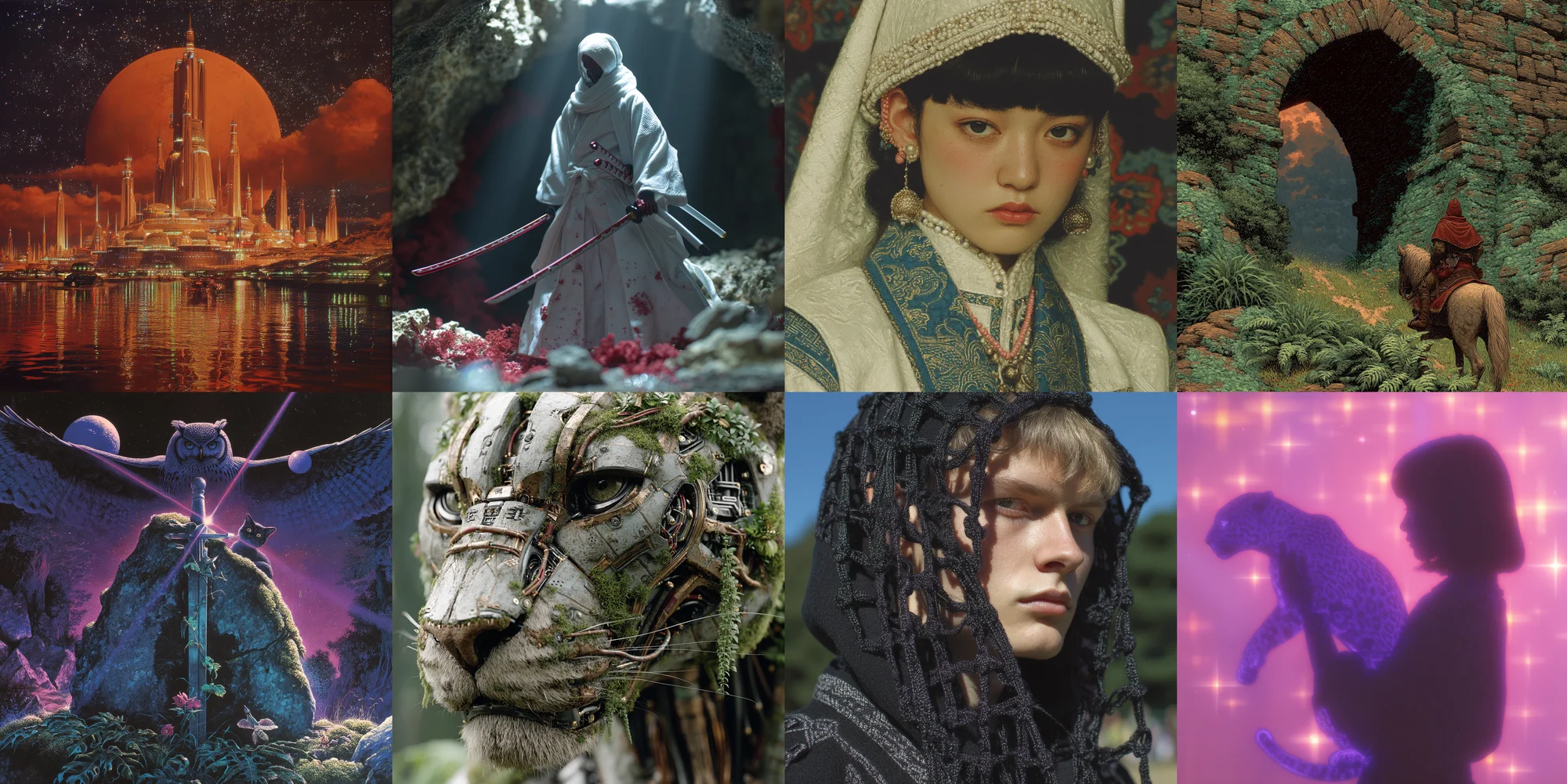
Sample grid from the official v7 alpha launch announcement, April 2025 — the baseline aesthetic every v7 subscriber is still working with today. Editorial portraits, rich textures, a measured balance of fantasy and realism. Source: updates.midjourney.com/v7-alpha.
v7 is the production default. You use it automatically at midjourney.com. It has been the default since June 2025, it is stable, and it supports every feature you have seen documented — style references, personalisation codes, moodboards, --cref, --oref, the full parameter set. If you do not go looking for anything else, this is what you are on.
v8 alpha shipped on 17 March 2026 at alpha.midjourney.com. That URL is a separate interface; you have to actively go there. Same account, same credits, different model behind the scenes. v8 is not on Discord. It is not on the main web interface.
v8.1 alpha shipped on 14 April 2026, same URL, supersedes v8. Midjourney has said v8.0 “will likely” be phased out after v8.1 stabilises, if no significant performance gaps emerge in the interim. In practice that means if you are on the alpha URL today, you are on v8.1 — v8.0 is a two-month window that is quietly closing.
None of the three is wrong to use. The question is which fits the job in front of you.
What v8 actually brought
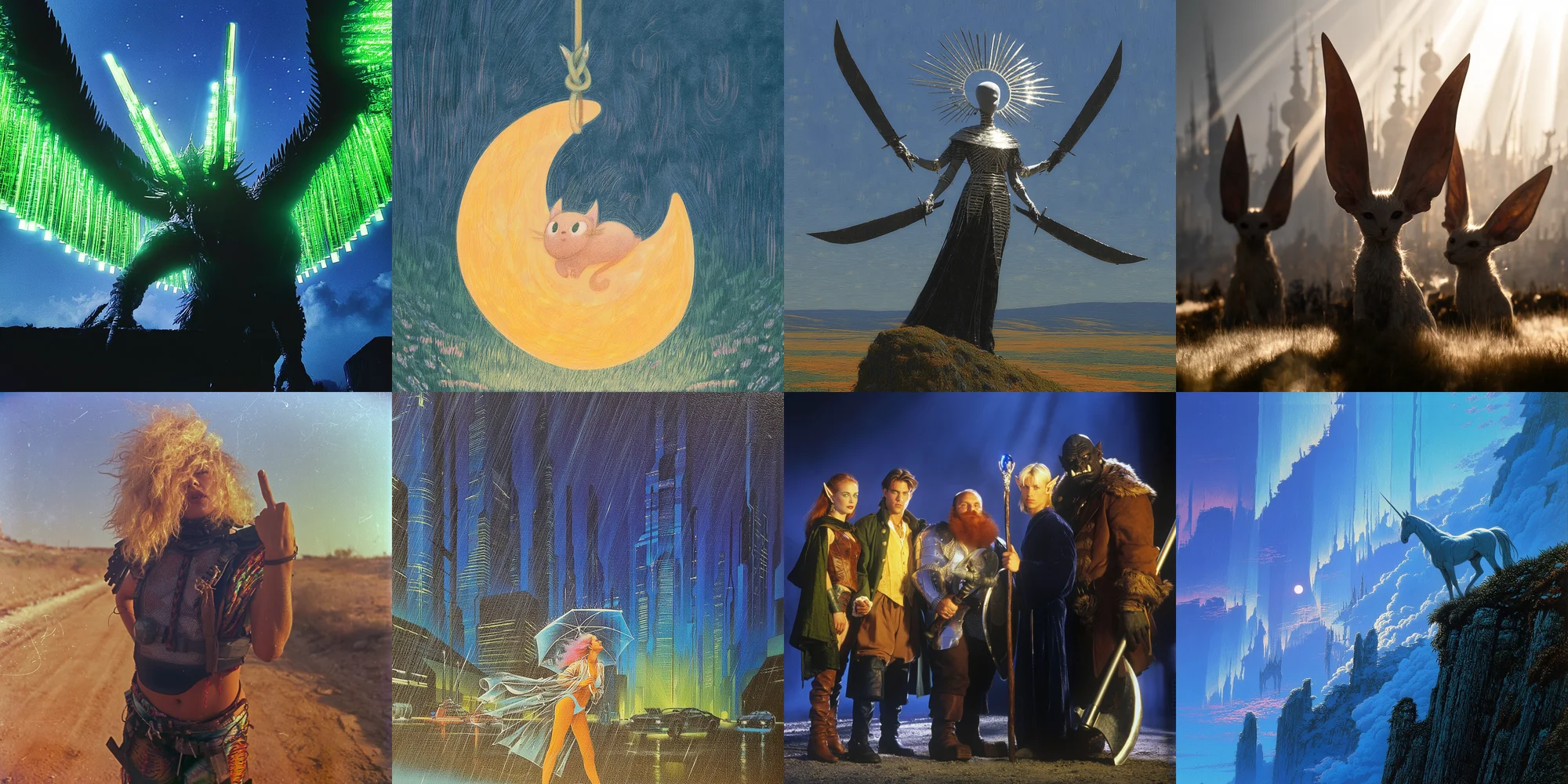
Sample grid from the official v8 alpha launch announcement. Note the lean toward fantasy, concept-art, and stylised illustration — v8’s aesthetic was noticeably bolder than v7’s, with heavier contrast and more pronounced styling. Source: updates.midjourney.com/v8-alpha.
v8 was not a point release. Midjourney described it as “an entirely new model with unique strengths and weaknesses,” and said it may require “totally new prompting styles.” That is a real warning, not marketing softness — short v7-style prompts (a woman in a garden --ar 3:4) produce more variable results on v8 than on v7, because v8 rewards more specific direction.
The headline changes:
- Roughly five times faster than v7 on a like-for-like job
- Native 2K resolution via
--hd, no post-generation upscale required - Better text rendering when text is placed in quotation marks in the prompt — still not perfect for complex typography, but meaningfully improved
- Improved prompt adherence — v8 follows detailed directions more closely
--q 4mode for an extra coherence pass- Web interface upgrades — grid mode for focused viewing, settings moved to sidebars
- Backwards compatible with v7 personalisation codes, style references, and moodboards
The caveat Midjourney themselves flagged, in the v8 launch notes: --hd, --q 4, style-reference jobs, and moodboard jobs each cost “4x as slow as regular jobs and each costs 4x (for now).” Relax mode was missing at launch; Turbo mode too. A v8 Standard-plan user who switched over and used --hd heavily could burn through fifteen Fast GPU hours in a day that used to last a week.
This was the friction point. It is largely why v8.1 exists.
What v8.1 changed
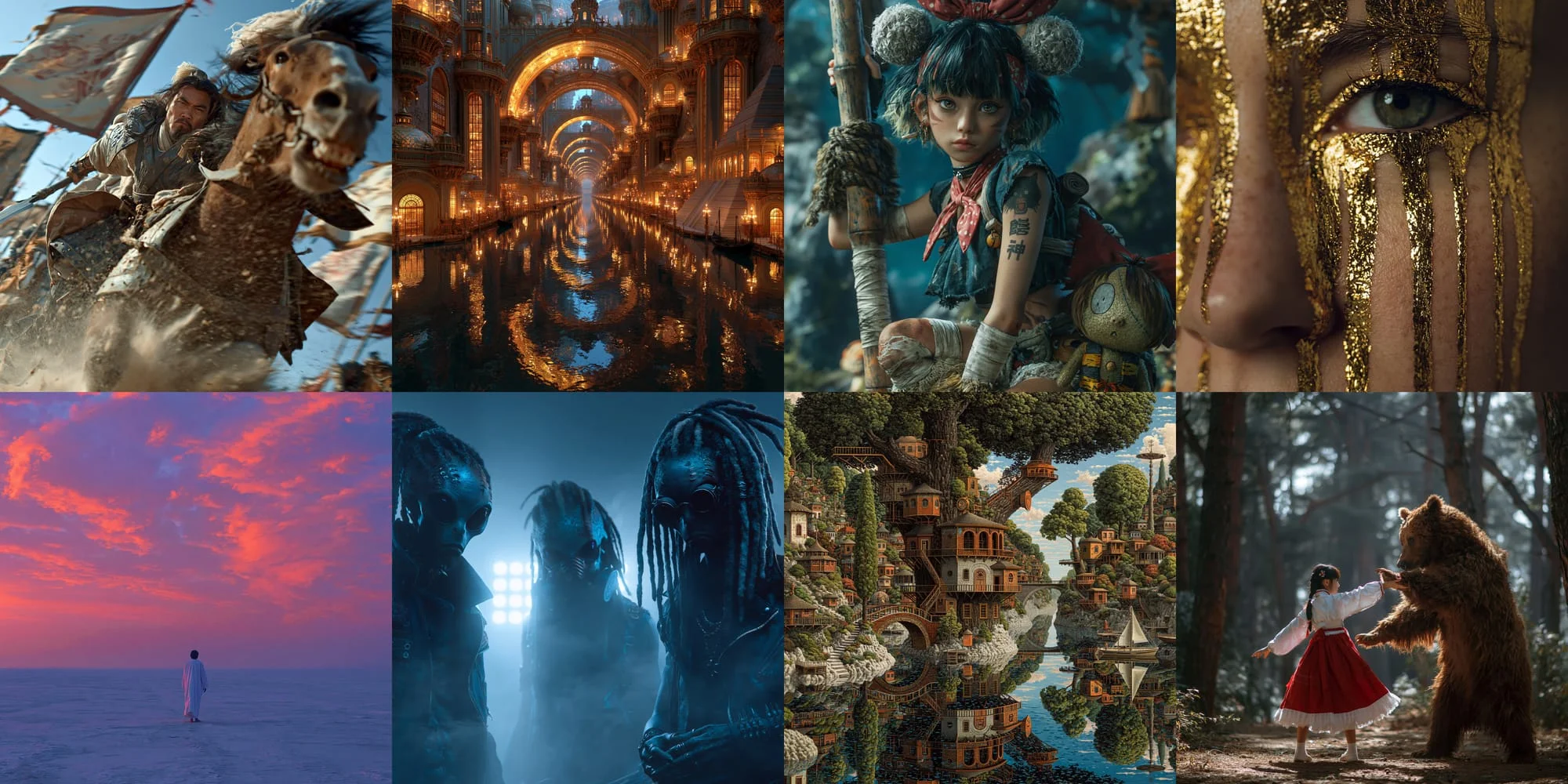
Sample grid from the official v8.1 alpha launch announcement. The aesthetic has pulled back toward something closer to v7 — more editorial, more photographic, less heavy-handed in styling. Compare this grid to the v8 grid above to see the correction in action. Source: updates.midjourney.com/v8-1-alpha.
v8.1 is the correction. It is not a new model — it is v8’s aesthetic and pricing sanded down.
- HD mode is now the default. You do not need to add
--hd. Standard rendering has moved to HD. - HD is 3× faster and 3× cheaper than v8.0’s HD was.
- Standard resolution is 50% faster and 25% cheaper — “as fast as V7 draft mode,” in Midjourney’s own phrasing. That is a real claim. v7’s draft mode was already very fast.
- Aesthetic smoothed toward a “consistent and familiar aesthetic in the spirit of V7.” v8.0 had a pronounced house style — higher highs, lower lows. v8.1 pulls that back.
- Moodboards and style references are “super stable” — the sref ecosystem that the community relies on now holds steady across v8.1 renders.
- Image prompts and image weights restored. They were missing or broken in v8.0. You can now pass reference image URLs directly again.
- Prompt Shortener auto-activates when your prompt exceeds length limits — a small quality-of-life fix, but a welcome one.
- Run as HD button lets you promote any standard-resolution job to an HD re-render without retyping the prompt.
- Updated Describe tool now generates longer, more detailed prompts from an input image.
v8 upscalers, and upgraded edit / inpaint / outpaint models, are still in development. Turbo mode and Relax mode status on v8.1 remain unclear as of writing.
The cost trap, simplified
At v8.0 launch, --hd and --q 4 each cost 4× a normal job. If you applied both flags, the cost compounded — exactly how is not specified in the launch notes, but Standard-plan users reported Fast hours evaporating. Combined with sref and moodboard jobs also being 4× in v8.0, a full-tilt v8.0 prompt could be multiples of what a v7 render cost.
In v8.1, most of that is gone. HD is the new default and is cheaper than v8.0 HD. Standard is cheaper than v7 was. The --q 4 option still exists for when you want the extra coherence pass, but the trap of stacking flags without knowing the cost is much smaller.
Practical rule: if you came off v8.0 feeling burned, try v8.1. It is not the same pricing surface.
Which to use right now
| Your goal | Use |
|---|---|
| Client work that needs to be reproducible next month | v7 — stable, fully documented, all features work |
| Stretching into the new model, willing to be on alpha UI | v8.1 — fast, cheaper than v8.0, aesthetic closer to v7 |
| You want the distinctive “v8.0 look” specifically | v8 alpha — but note it is being phased out |
| Rendering at 2K natively | v8.1 — HD is default, no flag needed |
| Heavy style-reference work | Either v7 or v8.1 — v8.1 is “super stable” for srefs, v7 has the full history |
| You need Relax mode | v7 — v8.1’s Relax status is unclear |
| You are on Discord, not the web | v7 — v8 and v8.1 are web-only for now |
The honest default for anyone reading this today is: stay on v7 for anything you need to be confident about; dip into v8.1 for exploration and speed. The two will converge when v8.1 becomes the main-site default, probably in the next few months.
What to watch for next
- v8.1 leaving alpha. When it does, the main
midjourney.comURL will start serving v8.1 by default, and the alpha/main split ends. There is no announced date. - Relax and Turbo returning. v8 launched without them. Relax is the unlimited-queue mode that keeps Standard plans viable; Turbo is the 2× cost / 4× speed option. Both are expected to come back but no timeline.
- v8 upscalers. The current upscale behaviour on v8.1 is adequate but not as refined as v7’s. The new upscalers are in development.
--crefdeprecation, eventually.--oref(omni-reference) has effectively superseded--crefsince May 2025.--crefstill works, but the long-term direction is--oreffor everything subject-related. No formal deprecation date has been given.- The
--svversion split. Style reference codes shipped before 16 June 2025 need--sv 4; newer codes use--sv 6(the current default). This quiet detail breaks most community code lists from 2024 and early 2025. It is the first thing to check when a code renders nothing like its preview.
If you already know where the platform is and want to go deeper, the Midjourney style reference pack is thirty-six curated --sref codes organised by aesthetic family — every one works on both v7 and v8.1. For how Midjourney sits among the other image models in 2026, see AI Image Models in 2026. And for the decision of which model to reach for on a given brief, Choosing Your Model is the short version.
Everything in this article is accurate as of 16 April 2026. Midjourney’s update cadence is monthly or faster; check updates.midjourney.com before relying on any specific cost multiplier or launch date in a production workflow.